VARDAAN LEARNING INSTITUTE
MOCK QUESTION PAPER (2025-26)
SOCIAL SCIENCE (CODE 087)
CLASS: X
Time Allowed: 3 Hours
Maximum Marks: 80
General Instructions:
- There are 38 questions in the Question paper. All questions are compulsory.
- The question paper has Four Sections – A (History), B (Geography), C (Political Science), and D (Economics).
- Each Section is of 20 Marks.
- Very Short Answer Type Questions (VSA) carry 2 marks each. Answers should not exceed 40 words.
- Short Answer Type Questions (SA) carry 3 marks each. Answers should not exceed 60 words.
- Long Answer Type Questions (LA) carry 5 marks each. Answers should not exceed 120 words.
- Case Based Questions (CBQ) carry 4 marks each and have three sub-questions. Answers should not exceed 100 words.
- Map-based questions carry 5 marks (History 2 marks + Geography 3 marks).
- There is no overall choice. However, an internal choice has been provided in few questions. Only one of the choices in such questions must be attempted.
SECTION A : HISTORY (20 Marks)
1. Match the following and choose the correct option:
1
| Column I | Column II |
|---|---|
| A. Giuseppe Mazzini | 1. Hosted the Congress of Vienna |
| B. Duke Metternich | 2. Chief Minister of Prussia |
| C. Otto Von Bismarck | 3. Young Italy |
| D. Kaiser William I | 4. Proclaimed German Emperor |
2. Identify the personality represented in the
caricature given below:
1
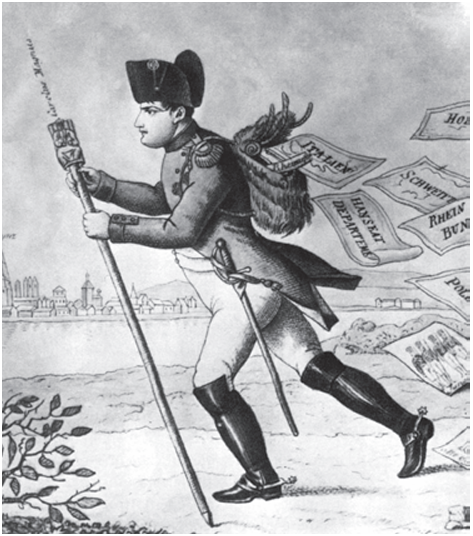
Note for Visually Impaired Candidates: Who remarked, "When France sneezes, the rest
of Europe catches cold"?
(a) Giuseppe Mazzini (b) Duke Metternich (c) Louis Philippe (d) Johann Gottfried Herder
(a) Giuseppe Mazzini (b) Duke Metternich (c) Louis Philippe (d) Johann Gottfried Herder
3. Arrange the following events related to the
Non-Cooperation Movement in chronological order:
1
I. Chauri Chaura incident
II. Khilafat Committee formed in Bombay
III. Gandhiji returns from South Africa
IV. Adoption of the Non-Cooperation program at Nagpur Session
II. Khilafat Committee formed in Bombay
III. Gandhiji returns from South Africa
IV. Adoption of the Non-Cooperation program at Nagpur Session
4. "Not all for the rich, but for the poor too." Who
among the following brought this change in the printing culture by selling penny chapbooks?
1
5A. "The decade of 1830s had brought great economic
hardship in Europe." Support the statement with two arguments.
2
OR
5B. How did the Treaty of Vienna (1815) change the map
of Europe? Give two points.
2
6A. Explain the role of women in the Civil
Disobedience Movement.
3
OR
6B. "The plantation workers in Assam had their own
understanding of Mahatma Gandhi and the notion of Swaraj." Support the statement.
3
7A. "Print culture created the conditions within which
French Revolution occurred." Analyze the statement with suitable arguments.
5
OR
7B. "The pre-modern world shrank greatly in the 16th
century." Justify this statement with reference to the role of technology and trade.
5
8. Read the source given below and answer the
questions that follow:
4
“Satyagraha is not physical force. A satyagrahi does not inflict pain on the adversary; he does not
seek his destruction… In the use of satyagraha, there is no ill-will whatever. Satyagraha is pure
soul-force. Truth is the very substance of the soul. That is why this force is called satyagraha.
The soul is informed with knowledge. In it burns the flame of love. … Non-violence is the supreme
dharma...”
(Source: Mahatma Gandhi)
(Source: Mahatma Gandhi)
8.1. What is the fundamental principle of Satyagraha according to Gandhiji? (1)
8.2. How does a Satyagrahi differ from a passive resister? (1)
8.3. "Satyagraha is pure soul-force." Explain the significance of this statement in the context of India's freedom struggle. (2)
8.2. How does a Satyagrahi differ from a passive resister? (1)
8.3. "Satyagraha is pure soul-force." Explain the significance of this statement in the context of India's freedom struggle. (2)
9. Map Skill Based Question:
2
Two places A and B have been marked on the given outline map of India. Identify them and write their
correct names:
A. The place where the Jallianwala Bagh massacre took place.
B. The place where Gandhiji organized a Satyagraha for cotton mill workers.
A. The place where the Jallianwala Bagh massacre took place.
B. The place where Gandhiji organized a Satyagraha for cotton mill workers.
SECTION B : GEOGRAPHY (20 Marks)
10. Which one of the following is the main cause of
land degradation in Punjab?
1
11. Match the crop with its description:
1
| Column I (Crop) | Column II (Description) |
|---|---|
| A. Tea | 1. Equatorial crop, requires high humidity |
| B. Rubber | 2. Beverage crop, labor intensive |
| C. Millets | 3. Known as coarse grains |
| D. Maize | 4. Used as both food and fodder |
12. Which of the following statements about 'Minerals'
is correct?
1
13. In which of the following states is the Corbett
National Park located?
1
14. Which mode of transportation reduces
trans-shipment losses and delays?
1
15. Identify the soil with the help of the following
features:
1
• Found in the Deccan trap (Basalt) region.
• Made up of extremely fine clayey material.
• Well-known for its capacity to hold moisture.
• Made up of extremely fine clayey material.
• Well-known for its capacity to hold moisture.
16. "India is rich in certain types of resources but
deficient in some other resources." Support this statement with two examples.
2
17A. "Manufacturing sector is considered the backbone
of development." Analyze this statement with reference to the economic growth of India.
5
OR
17B. "Agriculture and industry are not exclusive of
each other. They move hand in hand." Justify the statement with examples.
5
18. Read the given text and answer the
questions that follow:
4
“Water scarcity is possibly to happen in cases where water is sufficient or even abundant... many of
our cities are excellent examples. Thus, water scarcity may be an outcome of large and growing
population and consequent greater demands for water, and unequal access to it. A large population
requires more water not only for domestic use but also to produce more food. Hence, to facilitate
higher food-grain production, water resources are being over-exploited to expand irrigated areas for
dry-season agriculture.”
18.1. Mention one reason for water scarcity in cities despite abundance. (1)
18.2. How does over-exploitation of water for agriculture impact groundwater levels? (1)
18.3. Suggest two methods to conserve water in urban areas. (2)
18.2. How does over-exploitation of water for agriculture impact groundwater levels? (1)
18.3. Suggest two methods to conserve water in urban areas. (2)
19. Map Skill Based Question:
3
On the same outline map of India, locate and label the following with suitable symbols:
(a) Salal Dam
(b) A major Tea producing state in North-East India.
(c) OR Mumbai High (Oil Field)
(a) Salal Dam
(b) A major Tea producing state in North-East India.
(c) OR Mumbai High (Oil Field)
SECTION C : POLITICAL SCIENCE (20 Marks)
20. Which of the following countries has a 'Coming
Together Federation'?
1
21. Identify the correct statement regarding the
'Third Tier' of democracy in India.
1
22. Which one of the following is NOT a function of
political parties?
1
23. Assertion (A): Democracy is not
simply a rule by majority opinion.
Reason (R): The majority always needs to work with the minority so that governments function to represent the general view.
Reason (R): The majority always needs to work with the minority so that governments function to represent the general view.
1
24. "Power sharing is the very spirit of democracy."
Validate this statement with two points.
2
25. Mention any two constitutional provisions that
make India a secular state.
2
26. "Democracies accommodate social diversity."
Support the statement with three arguments.
3
27A. Explain the five major challenges faced by
political parties in India.
5
OR
27B. "Political parties are a necessary condition for
a democracy." Analyze the statement.
5
28. Read the given text and answer the
questions that follow:
4
“In Belgium, the Dutch-speaking community could take advantage of its numeric majority and force its
will on the French and German-speaking population. This would push the conflict among communities
further... In Sri Lanka, the Sinhala community enjoyed an even bigger majority and could impose its
will on the entire country... The democratic government in Sri Lanka adopted a series of
Majoritarian measures to establish Sinhala supremacy.”
28.1. What was the core cause of tension in Belgium? (1)
28.2. How did the approach of the Belgian leaders differ from that of the Sri Lankan leaders? (1)
28.3. Explain two consequences of the majoritarian policies adopted in Sri Lanka. (2)
28.2. How did the approach of the Belgian leaders differ from that of the Sri Lankan leaders? (1)
28.3. Explain two consequences of the majoritarian policies adopted in Sri Lanka. (2)
SECTION D : ECONOMICS (20 Marks)
29. Which of the following sectors contributes the
most to the GDP of India but employs fewer people compared to the Primary sector?
1
30. In a Self-Help Group (SHG), who decides on the
savings and loan activities?
1
31. Which of the following is a barrier on foreign
trade?
1
32. Find the incorrect option:
1
33. The process of rapid integration or
interconnection between countries is known as:
1
34. Money acts as an intermediate in the exchange
process, it is called:
1
35. "The problem of underemployment is not confined to
agriculture alone." Explain this statement with examples from urban areas.
3
36. Explain the role of the Reserve Bank of India
(RBI) in supervising the formal sector of loans.
3
37. "Cheap and affordable credit is crucial for the
country's development." Justify the statement with three arguments.
3
38A. "Globalization has been advantageous to consumers
as well as to producers." Analyze the statement.
5
OR
38B. "Terrorism, unfair trade practices, and dominance
of developed countries are challenges to the WTO." Explain the role of the World Trade
Organization (WTO) in this context.
5